
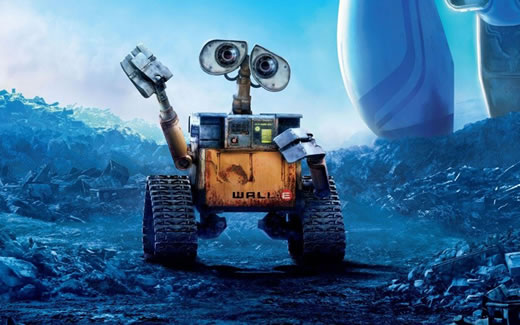
One of last years biggest blockbusters, Pixars animated master piece WALL-E addresses the ever-approaching over-contamination, over-consumption of earth and its resources. Delicately balanced in the forefront of this relevant and disturbing fear is a love story between a male robot, WALL-E and a female robot, EVE. Anyone watching this movie would come to the same conclusion; however, never once in the film are EVER or WALL-E identified as either male or female directly – by the use of “she” or “he – and, furthermore, it is common knowledge that robots are asexual biologically. So, where did this assumption of gender come from in the film?
At first glance, one could base these gender assumptions based solely on appearance and abbreviated names. EVE is a streamlined, egg-shaped (fertility), pure white robot with glowing light-blue eyes and a high-pitched voice box that signify a female leaning. WALL-E (“Wally”), by comparison, is more “male: rugged, dirty and boxy with a lower-pitched voice.
But then, as the characters are introduced, there is a discrepancy and even a total reversal of traditional gender roles that, upon thought, could switch around the gender titles. WALL-E is “out there” (signified immediately by the opening credit song by Michael Crawford). WALL-E keeps an affectionate pet cockroach and is often seen dancing and imitating, stereotypical homosexual male or “normal” female behaviour, scenes from a worn out VHS of Hello, Dolly! the musical. After several shots of dreamy pixel-ized eyes and the “holding hands” motion, it is clear that WALL-E is obsessed with the idea of love and companionship – again a very ste
 reotypical female emotional behaviour.
In contrast, EVE is focused on its “directive”. Brash, bigger and intense, EVE is quick to whip out it’s powerful blasters and shoot away when threatened. EVE rejects the advancements of WALL-E, who at first sight is infatuated, by disregarding his attempts to hold he hand. Later in the film, it is EVE who constantly is rescuing WALL-E, a perfect damsel-in-distress, and, in the dancing scene, is the one who leads. All these behaviours are reminiscent of a typical male archetype.
Despite these obvious behaviours, the audience will still recognize these characters as being male and female. Another aspect of this assumption is the heteronormativity of love-stories. A man and woman fall in love, so, naturally, when WALL-E (Wally) and EVE establish affectionate relationships; they must then be a man and a woman. It is then easiest to refer to the appearance and names of these characters as evidence that WALL-E is the man and EVE is the woman despite obvious behavioural patterns that suggest otherwise.
Perhaps the audience, who overlook the all-important behaviour, also use the roles of these characters as basis for the gender classification. EVE, though a more masculine character, is a vessel meant to harvest and transport, essentially, the last hope for humanity. This plant that EVE incubates on the way to the space station is undoubtedly connected to the idea of fertility and motherhood. WALL-E, though a more feminine character, is a down-and-dirty spirit who pursues it’s only meaning: it’s work. In other words, WALL-E is a bread-winner.
Pixar may or may not have been attempting to make a point about the interconnectedness between genders and gender characteristics. Regardless, the question that is posed is: would the audience have connected with genderless, asexual robots who presented no leaning towards classification and distinct roles? Probably not.

No comments:
Post a Comment
Note: Only a member of this blog may post a comment.