
Sure, the Disney princesses aren't all white. Mulan and Jasmine lead the forefront of Disney's racial diversity with pride. However, their characters are heavily americanized, or 'whitened'. Mulan, although Chinese in appearance, is loaded with Western ideology, as someone who believes in being forth-right and 'free-spirited'. Jasmine speaks English with an American accent, and falls in love with an anglicized Aladdin, who was reportedly modeled after Tom Cruise (Giroux, 2002).
Can fairytales only happen to people who speak English like “us”? What we have within Disney is an interaction with the Other. On behalf of American children, Disney has taken care of responding with hybridization, but it is as was warned about. The non-dominant cultures (cultures children here may not be so familiar with), are in many senses assimilated into American culture through a loss of language and accent. Rather than blend
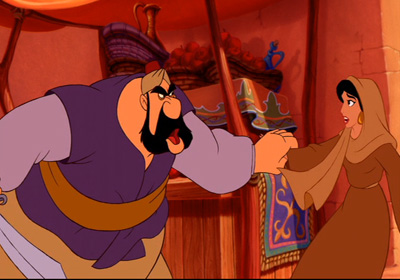 ing the two cultures, they have been melted in. Indeed, this could be seen as denying the experiences of Arabs, and refusing to acknowledge the characters of Jasmine and Aladdin as racial beings.
As a result, we have a reinforcement of white privilege. Not only can white children see their own race in one of the most popular sources of media for children in characters like Snow White or Sleeping Beauty, but also as taking over characters like Jasmine. There is also a certain degree of distancing oneself from the Other, by portraying members of other races that aren't recipients of fairytale dreams in barbaric and brutish ways. In Aladdin, the villain looks much less American, with darker skin and different facial hair. The same goes for the villain in Mulan, who is a large and intimidating man who wages war on the Emporer. Arabs are portrayed as perpetrators of torture, as in the opening song the line goes: “...where they'll cut of your ears if they don't like your face. It's barbaric but hey, it's home!” With such negative stereotypes projected onto these races, children are given the ability to define themselves with relevance to the Other. Americans are, as portrayed here, deserving of fairytale endings because they do not do barbaric things or engage in war.
As we come to a close on CRT, It is important to keep in mind that although dangerous acts of othering take race into account, being colour-blind is just as dangerous. Instead, CRT pushes us to understand race something that can play an important role in ones' identity, but it is by no means the only factor. The only way to work past many of the inequalities in society today is to acknowledge these differences, see the power struggles that lie behind them, and address them directly, questioning our perspectives and assumptions constantly rather than turning a blind eye to them.

No comments:
Post a Comment
Note: Only a member of this blog may post a comment.