Tuesday, September 29, 2009

Branches of Gender Theory


Critical Gender Theory can be divided up into several branches through which these questions (presented in the intro) can be answered in a more focused outlook. There is the Feminist Theory, referring to the analysis of literature and not the equal rights movement, which criticizes the dualism of male/female roles and focuses on the key ideas of equality, difference, and what that difference means in society.

Queer Theory rejects the idea of essential gender or fixed identity and also questions equality and difference when dealing with homosexuality; often critics seek to reveal the author’s sexuality based on his/her works.

Essentialist Theory advocates the pure biology of gender, gender roles, and sexuality, citing hormonal and physiological differences that account for the deep chasm of separation between men and women. A spin off of Essentialist theory is the idea of Heteronormativity or that heterosexuality is institutionalized and integrated into global society – for example the common sight of men's and women's bathrooms, yet the extremely rare sight of spaces for the transgendered or intersex. There are many, many more angles through which one can examine literature from a Gender perspective, but even given these main three, it is easy to see how sensitive and complicated Gender theory is, yet how simple and relevant its ideas are. For instance, the picture used for this post uses blue for the male sign, and pink for the female. Society, somehow, has assigned those colours to those genders. So, one way to look at it is that, despite the message of equality, the image still sends a message of separation defined by these colors.

WALL-E: Genderized Robots


One of last years biggest blockbusters, Pixars animated master piece WALL-E addresses the ever-approaching over-contamination, over-consumption of earth and its resources. Delicately balanced in the forefront of this relevant and disturbing fear is a love story between a male robot, WALL-E and a female robot, EVE. Anyone watching this movie would come to the same conclusion; however, never once in the film are EVER or WALL-E identified as either male or female directly – by the use of “she” or “he – and, furthermore, it is common knowledge that robots are asexual biologically. So, where did this assumption of gender come from in the film?

At first glance, one could base these gender assumptions based solely on appearance and abbreviated names. EVE is a streamlined, egg-shaped (fertility), pure white robot with glowing light-blue eyes and a high-pitched voice box that signify a female leaning. WALL-E (“Wally”), by comparison, is more “male: rugged, dirty and boxy with a lower-pitched voice.

But then, as the characters are introduced, there is a discrepancy and even a total reversal of traditional gender roles that, upon thought, could switch around the gender titles. WALL-E is “out there” (signified immediately by the opening credit song by Michael Crawford). WALL-E keeps an affectionate pet cockroach and is often seen dancing and imitating, stereotypical homosexual male or “normal” female behaviour, scenes from a worn out VHS of Hello, Dolly! the musical. After several shots of dreamy pixel-ized eyes and the “holding hands” motion, it is clear that WALL-E is obsessed with the idea of love and companionship – again a very stereotypical female emotional behaviour.

In contrast, EVE is focused on its “directive”. Brash, bigger and intense, EVE is quick to whip out it’s powerful blasters and shoot away when threatened. EVE rejects the advancements of WALL-E, who at first sight is infatuated, by disregarding his attempts to hold he hand. Later in the film, it is EVE who constantly is rescuing WALL-E, a perfect damsel-in-distress, and, in the dancing scene, is the one who leads. All these behaviours are reminiscent of a typical male archetype.

Despite these obvious behaviours, the audience will still recognize these characters as being male and female. Another aspect of this assumption is the heteronormativity of love-stories. A man and woman fall in love, so, naturally, when WALL-E (Wally) and EVE establish affectionate relationships; they must then be a man and a woman. It is then easiest to refer to the appearance and names of these characters as evidence that WALL-E is the man and EVE is the woman despite obvious behavioural patterns that suggest otherwise.

Perhaps the audience, who overlook the all-important behaviour, also use the roles of these characters as basis for the gender classification. EVE, though a more masculine character, is a vessel meant to harvest and transport, essentially, the last hope for humanity. This plant that EVE incubates on the way to the space station is undoubtedly connected to the idea of fertility and motherhood. WALL-E, though a more feminine character, is a down-and-dirty spirit who pursues it’s only meaning: it’s work. In other words, WALL-E is a bread-winner.

Pixar may or may not have been attempting to make a point about the interconnectedness between genders and gender characteristics. Regardless, the question that is posed is: would the audience have connected with genderless, asexual robots who presented no leaning towards classification and distinct roles? Probably not.

Otto Weininger and Sex and Character

Otto Weininger was a young, Austrian philosopher who did not gain recognition until after his suicide at age 23. Raised a Jew, Weininger converted to Christianity at age 20, as such, his only published book, Sex and Character, has a tone of religious anti-Semitism and delves deep into his misogynistic beliefs of gender and sex. His views and “genius” notably influenced Ludwig Wittgenstien , Jame Joyce (Ulysses), and Sigmund Freud.

Sex and Character theorizes that all living things possess both masculine (exclusively moral, right, productive and positive) qualities and feminine (amoral, wrong, unproductive and negative) qualities. It is here that Weininger found basis for his religious change, and that Hitler found justification for his extermination, as the book of Judaism states that it is a “feminine religion”, therefore amoral, and in contrast to Christianity – the masculine religion. He believed that “male” and “female” were not two entirely separate beings, but beings defined by either a predominantly male condition (articulate elements of thought separate from clear feelings) , or a predominantly female condition (sentimental, where thinking and feeling are the same). This, he believed, accounted for homosexuality, something all exude to some degree, as all men are, to some degree, women, and visa versa.

The largest focus of Sex and Character is that of genius: it’s distinction from talent, who possesses it vs. who can access it, and what that means. He believes that talent is hereditary, whereas genius is individual, and that ill-balanced individuals, particularity women, have not the capacity to appreciate, or act upon, their genius. “Woman,” he writes, “has no direct consciousness of [genius], she borrows a kind of imperfect consciousness from man.”

Sex and Character, however, was not written with a tone of complete hate and disregard for woman. Weininger believes that, despite the inferiority of woman, because every man possesses some feminine condition, no man has the right to denounce or defame a woman. However, he believes that freedom, in the sense that man deserves, can not be allowed to women as they consider themselves most free when most bound as the man is, essentially, in charge of all affairs.

Simone de Beauvoir and The Second Sex

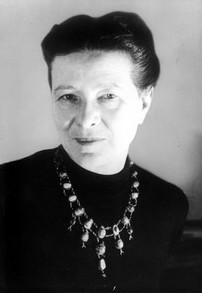
Simone de Beauvoir, one of the most celebrated of French existentialist writers and philosophers, constructed numerous works on ethics, politics and feminism and remains today an outstanding female philosopher to whom many feminist organisations refer.

The Second Sex
, was her most influential philosophical work and was inspired by Beauvoir’s deep interest in her own experience. It was an examination of women, men, their roles, sexuality, and society that revolved around a thesis that, to men, woman is always “the other” and that man defines himself, or his “masculinity” based on his opposition to this “otherness”. Beauvoir uses this conclusion, that otherness is just as important to a defined identity as self is. Beauvoir says that while female refers to anatomical and physiological features, woman is a cultural idea that relies and is a result of how men have seen women and how women have lived with this lopsided relationship.

Beauvoir looks at a multitude of texts to identify male dreams and fears in connection to the image of women. She argues that these images play a vital role and how, when the image is a positive one, such as the idea of femininity, all are pressed to conform to it, but when the image is negative, such a the image of prostitution, it applies to the entire sex.

A large aspect of Beauvoir’s theory centralizes on the roles women can adopt; wife, mother, lesbian, prostitute or mistress. In each case, the woman realises the power of the myth of femininity that demands the purely physical and is either objectified as an erotic object, or refuses to be an erotic. She views marriage as fate, not choice, due to its universal, moral and societal value and its ability to give women value in the eyes of men. Their relationship to work is also something that Beauvoir focuses on - saying that this is what primarily separates the sexes.

It was Beauvoir’s belief that a massive change had to occue - woman must be allowed economic freedom, and that this alone would increase the freedom of women exponentially, but contends that perfect equality can not exist in a capitalist society. She suggests socialism as the only true way to achieve equality and pushes women to reject the male myths of a female.

Gender Theory: An Intro

Gender is not just male and female; it is a concept. Gender is complicated. Gender theory goes beyond the simplicity of that male/female and uncovers layers upon layers of integrated theory, meaning, and questions to form multifaceted lenses through which one can examine literature.

What is it to be a man or a woman – is it based on biology or society? Who defines gender roles – is it nature or nurture? How has history shaped “femininity” and “masculinity”? What about the relationship between gender and sexuality – is homosexuality natural or wrong? How does society’s institutions and language create barriers and ideals around gender and sexuality? These are just a few questions answered by philosophers and posed when examining a text through the lens of Gender Theory. For more detail, see Branches of Gender Theory.

Firefly and Capital-based Class

Firefly is a TV series created by Joss Whedon that mixes a futuristic society with old-western archetypes and themes. Earth’s resources were depleted and humans were forced to terraform, or create new Earths, and the two remaining superpowers, China and the United States, have fused into a centralized super-power called the Alliance. The classes of the nine main characters within the ship and in relationship to the galactic situation influences how each character sees his or her world and how they interact with others.

The Alliance, and those living on the Allied planets are universally educated and protected through a rigid socialist system that gives the appearance of individualism, such as teaching a strict, government regulated curriculum that erases parts of history to sway the public. The classes that exist within the allied planets are those of middle, upper middle, and elite. Poverty is reserved for the outer-rim planets.

These outer-rim planets are beyond Alliance control, despite the fact that it was the Alliance that dropped small groups of colonizers on these desolate planets. Beyond rigid structure and privilege, it is the wild-west complete with tyrannical Barons, whose status is based solely on economic and, often, cultural capital, running townships and large-scale organized space crime that is based on money and goods.

This is the world that the main characters live on the fringe of. Thus, they are all outcasts to the norm. Despite their similar class in the eyes of the Alliance, that the nine characters can be seen to act and respond distinctly based on their class within the ship. Malcolm Reynolds, the captain of the crew, possesses prowess with aspects of social capital, such as linguistic and political, elevating him to this position of power. He is able to “adapt” (lie) his way into, and out of, situations that are profitable to him; these often have to do with the higher Allied class such as the episode when he attended a black-tie ball acting as an aristocratic business man. As the captain, he is constantly establishing bonds with other crime-leaders and checking up on the connections that provide him, and his crew, with jobs. One could argue that, in addition to his social capital, it is due to Malcolm’s possession of “wealth of experience”, or educational/cultural capitals, as a retired general elevate his status within the ship.

In this world, women can pursue the career of a “Companion”, which is reminiscent of Japanese Geishas, or artisans, who base their career on art, dance, conversation, and only occasional sexual experiences. Inara Serra is one of these high-status women. To the Alliance, she is a high-class individual due, most basically, to body capital and cultural capital, who serves the wealthy as a living example of social human perfection. On the ship, however, she serves another purpose: allowing the illicit actives perpetuated by the other crew members to go vastly unnoticed by the Alliance due to her respected class. Thus, she often uses this political capital to negotiate plans and to influence the Captain’s decisions.

The fugitive-surgeon, Simon Tam, has no economic capital or even particular social or cultural capital despite his previous adherence to the habitus (how the Alliance, in this case, deems he should act and the biases that accompany that). Instead, his importance within the crew is based on his educational capital as a doctor. The crew is often engaged in shoot-outs and it is almost every episode that someone is injured. Thus, the Captain and the rest of the crew place large value on Simon’s ability and prowess as a surgeon.
Each of the other characters possesses some form of capital. Zoe, the second-in-command, and Wash, the pilot, have educational/political; Kaylee, the mechanic, has educational; Book, a preacher, has cultural, linguistic, and educational; Jayne, “the muscle”, has body. However, the ninth character, River Tam, is notably and most interestingly enough, either void of capital, or entirely encompassing all, save for economic, types of capital. A psychic girl of 17, who has no control over her emotions and is mentally damaged, River swings between being a mute, far-off character, to a rambling philosopher, to a frightened, hateful child, to an assassin, as such it is difficult to classify her importance and class, yet she does present evidence of all capital. However, her assassin training provides her with educational, body, and political capital, and her mental issues often manifest in social, cultural and linguistic capital – such as when she impersonates a British captor and convinces him that she is from the same colony as he, complete with accent and manner.

Pierre Bourdieu and Distinction

Pierre Bourdieu is one the most influential sociologists and philosophers of class. He is best known for his book Distinction: A Social Critique of the Judgment of Taste in which he connects artistic judgements with social status. Most notably, he expanded on the ideas that class is defined by capital, that there are several kinds of capital, and that a habitus exists.
Bourdieu proposes the idea that, though class is predominantly defined by economic capital, so wealth and money, how people earn or inherit that wealth can be influences by other forms of capital. Cultural capital is the ability to “play the game of life”, so to speak, and is linked to social groups and the hierarchies within them. People who achieve success through connections and manners possess this kind of capital. Educational capital is an extension of cultural capital. Essentially, education is having a certificate of cultural capital. This explains why doctors and high-academics enjoy high class. Cultural capital is further broken down in other forms of capital, such as social capital, or the ability to make use of scholastic or cultural capital. Body capital, such as the fame obtained by models, is based on the possession of the socially-ideal body or the use of ones body to earn money. Political and linguist capital have to do, obviously, with political power and a handle on language in order to manipulate or command the situation.

Habitus, an idea Bourdieu pioneered and is now widely accepted, explains Cinderella-like situations. He proposes that classes have distinct characteristics, tastes, beliefs and values that are taught and perpetuated and that these characteristics influence an individual. However, this norm is only secondary to what an individual truly prefers or desires; thus we have the underdog situations. This concept also offers a possible basis for a cultural approach to structural inequality.

Antonio Gramsci


Hegemony, the struggle for power, and class divisions were key to the work of Gramsci. He challenged notions of purely economic-based classes, stating that "...class is too inert if it leads us to believe that workers, by virtue of their social position, always belong to the same class and possess the same attitudes and interests" (Booth et al, 2005). Instead, he pointed towards 'blocs', which he believed were created in shared historical moments.

Rather than viewing Hegemony as a potentially brutal form of coercion, Gramsci believed that the only way to take control, or to get other classes to consent to another's dominance was to hybridize the classes - to adapt certain aspects of the non-dominant classes with that of the one striving for power.

He also pointed towards the significance of intellectuals in classes or blocs, and divided them into two groups: traditional and organic. In the traditional stream we find those who run social institutions - schools, churches, media, etc. Organics, by contrast, are intellectuals that work against the established class in power (Booth et al, 2005). He felt that these intellectuals were the key change-makers for consent, bringing about ideological control for the dominant class, or ideological rebellion for the non-dominant classes (Booth et al, 2005). Therefore, it was not enough for the dominant class to control the institutions, but also needed strong intellectuals to run them, and to keep the coercion and consent steady. These intellectuals would also determine the nature of the ideology being projected by the dominant class.

Thus, Gramsci lead into the process of countering hegemony, or starting it anew with a different bloc or class. He argued that although one class may rise dominant after the shift that the majority of all non-dominant classes needed to be involved and agree with the change (Burke, 1999). This was quite contrary to the ideas of the time (and even now today) that a politcal party or group should try to bring about change on its own, and simply convince everyone else along the way.

Hegemony & The Dominant Class


Similar to the dominant race of CRT, Marxism and Class theory deals with a dominant class. This class dominates and controls the media (the spread of information), and the means of production, which provide the economic capital for all other classes and individuals. As such, they also have control over institutions such as schools, and dictate the political and cultural values.

But how does one particular class gain dominance? Simply by consent. Marxism stresses that there is always some form of consent in "being dominated". How this consent is brought about is up to the class seeking power, and can thus combine physical and mental assault to achieve consent (Stillo, n.d.). It need not always be violent, but has been in the past. Antonio Gramsci and Pierre Bordieu have their own views on the matter.

Class Theory: An Introduction


Class structures have been around since what seems like the dawn of time. Societies, to some extent, have always been based around different classes or groups, all based around different forms of capital.

We'll be taking a look at two branches of Class Theory - Marxism and Neo-Marxism, which classify individuals based on economic and cultural capital respectively. Marxism believes that as human beings ourselves we don't determine who we are, but rather our social being that determines us. This social being is determined by where we sit in a class structure. There are various schools of thought within class studies that view class structures differently. In Marxism, for example, ones' class is based on ones' “relationship to the means of production” (Etzioni-Halevy, 1976). Basically, if you own a factory you're higher class than someone who simply works in a factory, because you're “closer” to the means of production. But more relevant to today, it is simpler to say that economic wealth determines class. Marxism also looks at society through a dominant class. It believes that the culture of society is based only around the interests and traditions of the dominant class, and that the other classes really have no influence. This dominant class also has control over the media, which is something Antonio Gramsci is central to. We'll talk more about the dominant class and how they come to be in Hegemony.

Other schools of thought feel that it is not soley economic “capital” that determines ones class. Rather, it is seen as a combination of both economic and cultural capital, wherin cultural capital is composed of things like access to education and social manners or norms. Boudoire is a well-known thinker of this stream, and we'll be taking a look at him later on.

Disney: White Privilege and the Other

Disney isn't known for being the most innocent of media conglomerates, but with such a hold on the family market the criticism is certainly well-deserved. But past the well-known sexual suggestiveness, there lies an inherent history of racism and whiteness. Of course, Disney deals in fairytales. They cater to a market of young children, many of them female, who want the happy ending and the perfect romance. On the whole, things seem fairly typical as far as fairytales go. But once we start to look at who actually gets those happy endings, a strong pattern of racism emerges.

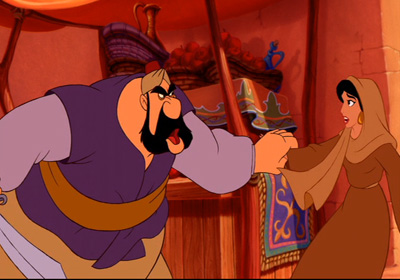
Sure, the Disney princesses aren't all white. Mulan and Jasmine lead the forefront of Disney's racial diversity with pride. However, their characters are heavily americanized, or 'whitened'. Mulan, although Chinese in appearance, is loaded with Western ideology, as someone who believes in being forth-right and 'free-spirited'. Jasmine speaks English with an American accent, and falls in love with an anglicized Aladdin, who was reportedly modeled after Tom Cruise (Giroux, 2002).

Can fairytales only happen to people who speak English like “us”? What we have within Disney is an interaction with the Other. On behalf of American children, Disney has taken care of responding with hybridization, but it is as was warned about. The non-dominant cultures (cultures children here may not be so familiar with), are in many senses assimilated into American culture through a loss of language and accent. Rather than blending the two cultures, they have been melted in. Indeed, this could be seen as denying the experiences of Arabs, and refusing to acknowledge the characters of Jasmine and Aladdin as racial beings.

As a result, we have a reinforcement of white privilege. Not only can white children see their own race in one of the most popular sources of media for children in characters like Snow White or Sleeping Beauty, but also as taking over characters like Jasmine. There is also a certain degree of distancing oneself from the Other, by portraying members of other races that aren't recipients of fairytale dreams in barbaric and brutish ways. In Aladdin, the villain looks much less American, with darker skin and different facial hair. The same goes for the villain in Mulan, who is a large and intimidating man who wages war on the Emporer. Arabs are portrayed as perpetrators of torture, as in the opening song the line goes: “...where they'll cut of your ears if they don't like your face. It's barbaric but hey, it's home!” With such negative stereotypes projected onto these races, children are given the ability to define themselves with relevance to the Other. Americans are, as portrayed here, deserving of fairytale endings because they do not do barbaric things or engage in war.

As we come to a close on CRT, It is important to keep in mind that although dangerous acts of othering take race into account, being colour-blind is just as dangerous. Instead, CRT pushes us to understand race something that can play an important role in ones' identity, but it is by no means the only factor. The only way to work past many of the inequalities in society today is to acknowledge these differences, see the power struggles that lie behind them, and address them directly, questioning our perspectives and assumptions constantly rather than turning a blind eye to them.

The Bells are Ringing

As we mentioned, bell hooks and Derrick Bell are core to CRT. Derrick Bell is famous for leaving Harvard after the institution refused to grant an Asian-American woman permanent employment (Isaksen, 2000). Bell has been mainly involved in challenging the law as a perpetrator of racism - providing benefit only to the dominant race (Isaksen, 2000). Much of Bell's work has been centered around the concept of "interest-convergence", in which those in power (here, the dominant race) only support the interests of others if it does no harm to their own interest and status. Bell has applied this mostly to civil liberties and social justice (Brophy, 2009). Bell also feels that even with "Herculean" efforts, there will never be racial equality, as whiteness and white power are too ingrained in society today (Curry, n.d.). He has further been critical of http://chud.com/nextraimages/aladdin2.JPG found in schools. When he was hired as a result of a demand for an African-American professor after the assassination Dr. Martin Luther King, Jr, he lacked traditional "professional" credentials, such as a degree. But he referred to these required credentials as "exclusionary constructs of a racist white power structure...[seeking] to deny blacks an opportunity to teach at the nation's elite schools"(Discover the Networks, 2005).

bell hooks, on the other hand, is concerned more with racial identity. Essentialism, which advocates the idea of having a fixed 'essence' attached to certain (racial) groups (Twine, 2001), is something hooks feels strongly against. Whether it is used strategically by a group to create a sense of unity, or with racist connotations, hooks feels that it only encourages racism and prevents progress. Much of her teachings and writings on race question where the "identities" (stereotypes) come from in the first place. In her essay "Killing Rage" she questions the association of "black rage" with the lower-class and colonized, after experiencing rage-inducing situation in an airport.

Micro-Aggressions


Racism is usually thought of in terms of clearly visible or audible manifestations: racist jokes, hate crimes, etc. CRT; however, looks at the more subtle and inherent forms of racism - often those that seem harmless, but are in reality laden with strong messages of racism. One of the most common examples is the question: “Where were you born”? For the individual posing the question, it may be a way to take a general interest in the life of another. But the problem with the question is that it implies that the person the question is being posed to could not possibly be born in the country they currently live in, on account of their skin colour.

The National Film Board's Citizen Shift has a series on Racial Justice. These kinds of microaggressions come up in the vast majority of them. Our favourites: Slip of the Tongue, Cute but Confused, and What Are You Anyways?. Additionally, the Work for All collection on the NFB offers great insight into institutionalized micro aggressions in Canada.

Furthermore, Lily on 8Asians has a great post on micro-aggressions, as well as a handy table.

Whiteness


As we discussed in Le Grande Autre, the act of othering is not only distancing oneself from the Other, but also making onself the norm, or neutral. Whiteness refers to this as it applies to "whites", particularly in North America. As a result of this “normativeness” which has become ingrained in North American society, whites are given certain institutional privileges. Among them being the ability to learn about their own history in school, not being subject to job refusals based on race (generally speaking), and having overwhelming representation in the media and politics (Media Awareness Network, 2008). Many see Whiteness as having originated in colonialism, when othering was at its strongest, and whites were exerting their power as the dominant race.

Le Grande Autre

One of the most predominant focuses of critical race theory is the idea of the “Other”, both in literature and in human interaction. Greatly similar to the concept of the “unknown”, it examines initial interactions between races that are unfamiliar to each other, both on an individual and collective scale.

CRT proposes that there are two basic ways to deal with an encounter with the Other (Bonnycastle, 2007):
  • Stick with one's own experience, and be relatively uninfluenced
As readers, this is the first and most common response for many, depending on the literature. If readers find it hard to imagine having anything in common with the Other, it is easier for most to simply stick to their own experiences. Of course, this is also true in reality. This lack of ability to connect often results in distancing oneself from the Other, which is called "othering". Not only is it a process of distancing, but also a way of identifying oneself with relation to what the Other is, and oneself is not. It is the enforcement of “us” and “them”, by characterizing the Other as non-normative, and making ones own cultural or ethnic group the “norm” - pure, clean, and neutral (Shapiro, 2008). Not only does this have dire consequences in manifestations of racism, but it also results in a fragile identity for the entity doing the othering. As they are basing their identity only on what they are not, and priding themselves on being removed and different from the Other, when faced with similarities between oneself and the Other, this identity can be quick to crumble (Ulrich, 2004).
  • Develop a response that mixes elements of oneself with elements of the Other
This is said to be the most common of responses. Most people simply cannot be unaffected by encountering the Other. This response is often referred to as hybridization, but many warn of the dangers that can be involved with this sort of “melting pot” way of thinking. Often, this hybridization results in the Other or the non-dominant culture being assimilated into the dominant culture, rather than blending the two. Unfortunately, this denies individuals of their racial or ethnic experiences, and deny them as racial or cultural beings. Similarly, it can manifest in taking a 'colour-blind' approach, which denies the same senses of identity.

Race Theory: An Introduction

We're going to start off with a walk through race theory. This will be no leisurely stroll, as the theory has its roots in challenging racism in institutional structures of North America - schools and the law. Critical race theory (CRT) examines the relationships that exist between different ‘races’: the nature of those relationships and the interactions that compose them (Isaksen, 2000). These relationships are both external and internal, and attempting to dig deeper into them quickly becomes quite complex. Yet, this is exactly what CRT aims to do.

For external relationships, CRT looks at every-day interactions between individuals of different races, institutions and individuals, and different ethnic groups as wholes. Like many critical theories, it believes that there are more to actions and words than meet the eye, but also more than what individuals might knowingly intend or portray with their own actions and conversations. Instead, these interactions are viewed as charged with age-old power struggles. In these examinations, a few key questions are formed: How do individuals of different races interact, especially if there has been little exposure to the “Other? How are these interactions viewed and dealt with by individuals of the dominant race, especially considering a history of colonization? Questions like these are addressed through some of the main ideas of race theory: Otherness and Micro-Aggressions.

For more internal relationships, the examinations are similar, but focus on the identities that shape the external interactions. To what extent is race or ethnicity a social construction? To what extent does race, social construction or not, shape an individual's identity? What about (essential) group identity? We'll look at this in our post on Whiteness, and bell hooks, as one of the most important theologians in Race Theory history. We'll also be looking at Derrick Bell, the man behind the CRT movement.

Welcome!

Welcome to The Treasure Box of Critical Theory. We hope that you'll find plenty of theoretical gems here to satisfy your thirst for booty. We mean.. educational capital.

We hope to portray the basics of some major critical theories: Race, Class, and Gender, and point out where we found relevant examples in literature and media.
Enjoy!